nmfae.kernel.beta.cv selects the optimal beta parameter of the
kernel function by evaluating nmf.rrr.cv for each candidate value.
The kernel matrix \(A = K(U, V; \beta)\) replaces \(Y_2\) in the three-layer
NMF model.
When beta = NULL, candidate values are automatically generated via
nmfkc.kernel.beta.nearest.med.
Usage
nmf.rrr.kernel.beta.cv(
  Y1,
  rank1 = 2,
  rank2 = NULL,
  U,
  V = NULL,
  beta = NULL,
  plot = TRUE,
  ...
)
Arguments
- Y1
Output matrix \(Y_1\) (P1 x N). Non-negative.
- rank1
Integer. Rank of the response basis. Default is 2.
- rank2
Integer. Rank of the covariate basis. Default (
NULL) =rank1.- U
Covariate matrix \(U\) (K x M). Rows are features, columns are samples (or knot points for non-symmetric kernels).
- V
Covariate matrix \(V\) (K x N). If
NULL(default),V = Uand a symmetric kernel is used.- beta
Numeric vector of candidate beta values. If
NULL, automatically determined vianmfkc.kernel.beta.nearest.med.- plot
Logical. If
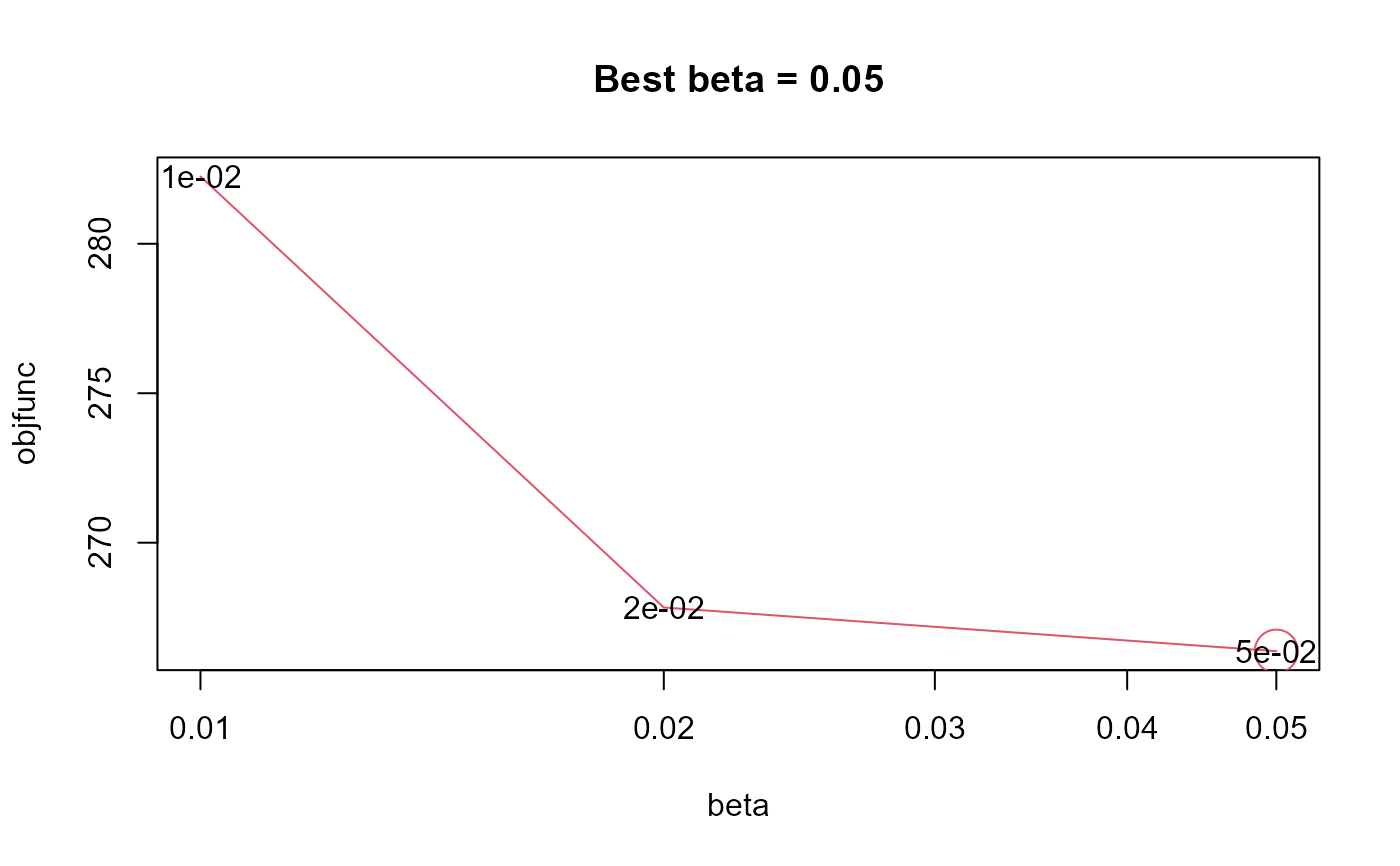
TRUE(default), plots the objective function curve.- ...
Additional arguments. Kernel-specific args (
kernel,degree) are passed tonmfkc.kernel; all others (div,seed,shuffle,epsilon,maxit, etc.) are passed tonmf.rrr.cv. Also acceptscoresto evaluate the candidatebetavalues in parallel (defaultgetOption("mc.cores", 1L)); each inner CV then runs sequentially, and because results are gathered in order the selectedbetais identical for anycores. For backward compatibility,QandRare accepted as aliases forrankandrank.encoder.Rank aliases accepted here for backward compatibility:
Qforrank1,Rforrank2.
Value
A list with components:
- beta
The beta value that minimizes the cross-validation objective.
- objfunc
Named numeric vector of objective function values for each candidate beta.