nmfkc.kernel constructs a kernel matrix from covariate matrices.
It supports Gaussian, Exponential, Periodic, Linear, Normalized Linear, and Polynomial kernels.
Usage
nmfkc.kernel(
  U,
  V = NULL,
  kernel = c("Gaussian", "Exponential", "Periodic", "Linear", "NormalizedLinear",
    "Polynomial"),
  ...
)
Source
Satoh, K. (2026). Applying Non-negative Matrix Factorization with Covariates to the Longitudinal Data as Growth Curve Model. American Journal of Mathematical and Management Sciences. In press. arXiv:2403.05359. https://arxiv.org/abs/2403.05359
Arguments
- U
Covariate matrix \(U(K,N) = (u_1, \dots, u_N)\). Each row may be normalized in advance.
- V
Covariate matrix \(V(K,M) = (v_1, \dots, v_M)\), typically used for prediction. If
NULL, the default isU.- kernel
Kernel function to use. Default is
"Gaussian". Options are"Gaussian","Exponential","Periodic","Linear","NormalizedLinear", and"Polynomial".- ...
Additional arguments passed to the specific kernel function (e.g.,
beta,degree).
Examples
# Example.
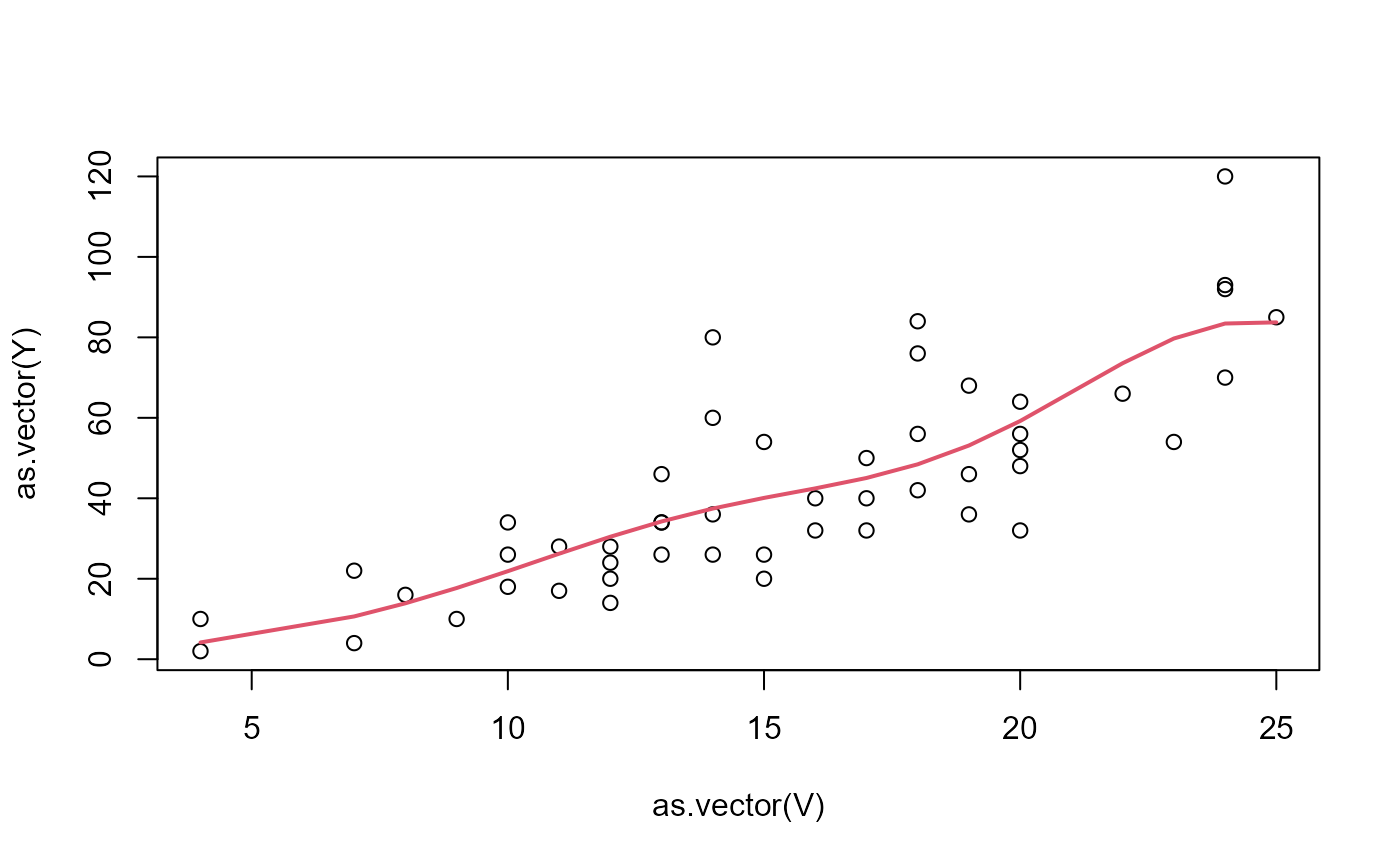
Y <- matrix(cars$dist,nrow=1)
U <- matrix(c(5,10,15,20,25),nrow=1)
V <- matrix(cars$speed,nrow=1)
A <- nmfkc.kernel(U,V,beta=28/1000)
dim(A)
#> [1]  5 50
result <- nmfkc(Y,A,rank=1)
#> Y(1,50)~X(1,1)C(1,5)A(5,50)=XB(1,50)...
#> 0sec
plot(as.vector(V),as.vector(Y))
lines(as.vector(V),as.vector(result$XB),col=2,lwd=2)