NMF-RE: Mixed-Effects Modeling with nmfkc
Source:vignettes/nmf-re-with-nmfkc.Rmd
nmf-re-with-nmfkc.RmdIntroduction
This vignette demonstrates NMF-RE (Non-negative
Matrix Factorization with Random Effects), a mixed-effects extension of
NMF implemented in the nmfkc package.
Why Mixed Effects?
Standard NMF with covariates models the data as: \[Y \approx X \Theta A\]
where \(\Theta A\) captures systematic (fixed) effects of covariates \(A\) on latent scores. However, in many applications — such as longitudinal studies, panel data, or clustered observations — individuals exhibit unit-specific deviations that cannot be explained by covariates alone.
NMF-RE addresses this by adding random effects \(U\): \[Y = X(\Theta A + U) + \mathcal{E}\]
- \(Y\) (\(P \times N\)): Non-negative observation matrix (e.g., repeated measurements over \(P\) time points for \(N\) subjects).
- \(X\) (\(P \times Q\)): Non-negative basis matrix learned from data.
-
\(\Theta\) (\(Q \times K\)): Coefficient matrix for
covariate effects (denoted
Cin the package output). - \(A\) (\(K \times N\)): Covariate matrix (e.g., intercept, sex, treatment).
- \(U\) (\(Q \times N\)): Random effects matrix capturing individual deviations.
- \(\mathcal{E}\): Residual noise with variance \(\sigma^2\).
The random effects follow \(\mathrm{Var}(\mathrm{vec}(U)) = \tau^2 I\), and the penalty \(\lambda = \sigma^2 / \tau^2\) determines the degree of shrinkage. The marginal model is \[\boldsymbol y_n \sim N\!\big(X\Theta\boldsymbol a_n,\; \tau^2 X X^\top + \sigma^2 I\big).\]
Key Features
- EM/ECM estimation: An outer–inner ECM algorithm alternates a ridge/BLUP step for \(U\), a semi-NMF step for the basis \(X\), and a fixed-effect update for \(\Theta\) (inner loop, fixed \(\lambda\)), with EM M-steps for \((\sigma^2, \tau^2)\) (outer loop). The variance components are estimated from the data — there is no tuning parameter to set.
-
Sign-free or non-negative coefficients via
C.signed(see below). - Wild bootstrap inference: Standard errors, z-values, p-values, and confidence intervals for \(\Theta\) without repeated constrained re-optimization.
- Trace-based ICC: Quantifies the proportion of variance attributable to random effects.
Sign convention: C.signed
The single argument C.signed selects the whole
estimation scheme:
-
C.signed = TRUE(default, recommended): the coefficients \(\Theta\) are treated as real-valued (sign-free), updated by exact least squares. Inference uses a two-sided test (interior null \(H_0: \Theta_{qk} = 0\)). This is the natural choice when covariate effects can be positive or negative. -
C.signed = FALSE: \(\Theta\) is constrained to be non-negative, updated by a multiplicative update, with a one-sided test (boundary null \(H_0: \Theta_{qk} = 0\) vs \(H_1: \Theta_{qk} > 0\)). Use this for compositional or intensity-type scores.
In both cases the basis \(X\) is always non-negative.
1. Data: Orthodont (Longitudinal Growth)
We use the Orthodont dataset from the nlme
package: orthodontic distance measurements for 27 children at ages 8,
10, 12, and 14. The covariate of interest is sex (Male/Female).
library(nmfkc)
library(nlme)
#> Warning: package 'nlme' was built under R version 4.4.3

data(Orthodont, package = "nlme")
head(Orthodont)
#> Grouped Data: distance ~ age | Subject
#>   distance age Subject  Sex
#> 1     26.0   8     M01 Male
#> 2     25.0  10     M01 Male
#> 3     29.0  12     M01 Male
#> 4     31.0  14     M01 Male
#> 5     21.5   8     M02 Male
#> 6     22.5  10     M02 Male
1.1 Prepare the Observation Matrix Y
Each column of \(Y\) is a subject, each row is a time point (age). Since there are 4 ages and 27 subjects, \(Y\) is \(4 \times 27\).
Y <- matrix(Orthodont$distance, nrow = 4, ncol = 27)
colnames(Y) <- paste0("S", 1:27)
rownames(Y) <- paste("Age", c(8, 10, 12, 14))
Y[, 1:6]
#>        S1   S2   S3   S4   S5   S6
#> Age 8  26 21.5 23.0 25.5 20.0 24.5
#> Age 10 25 22.5 22.5 27.5 23.5 25.5
#> Age 12 29 23.0 24.0 26.5 22.5 27.0
#> Age 14 31 26.5 27.5 27.0 26.0 28.5
1.2 Prepare the Covariate Matrix A
We create a \(2 \times 27\)
covariate matrix with an intercept row and a binary male
indicator.
male <- ifelse(Orthodont$Sex[seq(1, 108, 4)] == "Male", 1, 0)
A <- rbind(intercept = 1, male = male)
A[, 1:6]
#>           [,1] [,2] [,3] [,4] [,5] [,6]
#> intercept    1    1    1    1    1    1
#> male         1    1    1    1    1    1
2. Fitting the NMF-RE Model
We fit the model with rank = 1 (a single latent growth
trend). No tuning parameter is required: the variance components \((\sigma^2, \tau^2)\), and hence the penalty
\(\lambda\), are estimated by the
EM/ECM algorithm. We keep the default C.signed = TRUE,
since the male effect on growth could in principle have either sign. The
prefix argument labels the basis.
res <- nmfre(Y, A, rank = 1, prefix = "Trend")2.1 Model Summary (fit)
nmfre() performs optimization only.
summary() on a freshly fitted object shows the variance
components, fit statistics, and the \(\mathrm{df}_U\) diagnostic; standard errors
and p-values for \(\Theta\) are added
in a separate inference step (Section 2.2), mirroring the
nmfkc() / nmfkc.inference() split.
summary(res)
#> NMF-RE: Y(4,27) = X(4,1) [C(1,2) A + U(1,27)]
#> Iterations: 41 / 5000 (converged)  epsilon = 1e-05  outer 20 / 500
#> R-squared (cor^2):    0.8246 (XB+blup), 0.4167 (XB)
#> R-squared (uncentered):     0.9974 (XB+blup), 0.9915 (XB)
#> R-squared (centered): 0.7594 (XB+blup), 0.2134 (XB)
#>
#> Variance components:
#>   sigma2 = 1.933  (residual)
#>   tau2   = 48.19  (random effect)
#>   lambda = 0.04011  (sigma2 / tau2)
#>   ICC    = 0.6100  (tau2*tr(X'X) / (tau2*tr(X'X) + sigma2*P))
#>   dfU    = 23.28
#>
#> Coefficients (Theta): run nmfre.inference(fit, Y, A) for SE / p-values.
Variance components:
- \(\sigma^2\): Residual variance (measurement noise).
- \(\tau^2\): Random effect variance (individual heterogeneity).
- \(\lambda = \sigma^2/\tau^2\): The shrinkage penalty on \(U\), derived from the estimated variances.
- ICC: Proportion of variance from random effects. Higher ICC means stronger individual differences relative to noise.
-
\(\mathrm{df}_U\): The effective
degrees of freedom consumed by the random effects, reported purely as a
complexity diagnostic (the saturation ratio \(\mathrm{df}_U/(NQ)\) is shown by
res$dfU.frac). No cap is imposed.
cat("sigma^2 =", round(res$sigma2, 4), "\n")
#> sigma^2 = 1.9328
cat("tau^2   =", round(res$tau2, 4), "\n")
#> tau^2   = 48.1908
cat("lambda  =", round(res$lambda, 5), "\n")
#> lambda  = 0.04011
cat("dfU     =", round(res$dfU, 2),
    "  dfU/(NQ) =", round(res$dfU.frac, 4), "\n")
#> dfU     = 23.28   dfU/(NQ) = 0.8622
R-squared:
- \(R^2\) (XB+blup): Fit including both fixed and random effects.
- \(R^2\) (XB): Fit from fixed effects only — the gap shows how much the random effects improve the fit.
2.2 Inference on \(\Theta\) with
nmfre.inference()
To obtain standard errors, z-values, p-values, and confidence
intervals for \(\Theta\), pass the fit
to nmfre.inference() (sandwich SE + wild bootstrap,
conditional on the estimated \(\hat X, \hat
U\)). It returns the same object with the inference fields added,
so summary() now prints the coefficient table.
res <- nmfre.inference(res, Y, A, wild.B = 1000)
summary(res)
#> NMF-RE: Y(4,27) = X(4,1) [C(1,2) A + U(1,27)]
#> Iterations: 41 / 5000 (converged)  epsilon = 1e-05  outer 20 / 500
#> R-squared (cor^2):    0.8246 (XB+blup), 0.4167 (XB)
#> R-squared (uncentered):     0.9974 (XB+blup), 0.9915 (XB)
#> R-squared (centered): 0.7594 (XB+blup), 0.2134 (XB)
#>
#> Variance components:
#>   sigma2 = 1.933  (residual)
#>   tau2   = 48.19  (random effect)
#>   lambda = 0.04011  (sigma2 / tau2)
#>   ICC    = 0.6100  (tau2*tr(X'X) / (tau2*tr(X'X) + sigma2*P))
#>   dfU    = 23.28
#>
#> Coefficients:
#>                   Estimate Std. Error (Boot) z value Pr(>|z|)
#> intercept:Trend1    90.506      2.472  2.524   36.62   <2e-16 ***
#>      male:Trend1     9.423      3.057  3.070    3.08 0.002052 **
#> ---
#> Signif. codes:  0 '***' 0.001 '**' 0.01 '*' 0.05 '.' 0.1 ' ' 1
#> C (= Theta) update: sign-free (real-valued); p-values two.sided
Coefficient table (\(\Theta\)):
- Estimate: Effect of each covariate on the latent trend.
- Std. Error: Analytic (sandwich) standard error; the (Boot) column is the wild-bootstrap standard error.
-
Pr(>|z|): With the default
C.signed = TRUE, this is a two-sided p-value (\(H_0: \Theta_{qk} = 0\)). Both the intercept and the male effect are detected as statistically significant.
The sidedness follows the fit: sign-free \(\Theta\) (C.signed = TRUE)
uses a two-sided test, while the non-negative variant
(C.signed = FALSE) uses a one-sided (boundary) test.
3. Visualization
We plot the growth curves to see how the model captures both population-level trends (fixed effects) and individual deviations (random effects).
age <- c(8, 10, 12, 14)

plot(age, res$XB[, 1], type = "n", ylim = range(Y),
     xlab = "Age (years)", ylab = "Distance (mm)",
     main = "Orthodont: NMF-RE Growth Curves")

# Plot observed data points
for (j in 1:27) {
  pch_j <- ifelse(male[j] == 1, 4, 1)
  points(age, Y[, j], pch = pch_j, col = "gray60")
}

# Plot individual predictions (fixed + random effects)
for (j in 1:27) {
  lines(age, res$XB.blup[, j], col = "steelblue", lty = 3, lwd = 0.8)
}

# Plot population-level fixed effects (two lines: male and female)
for (j in 1:27) {
  lines(age, res$XB[, j], col = "red", lwd = 2)
}

legend("topleft",
  legend = c("Fixed effect (male/female)", "Fixed + Random (BLUP)",
             "Male (observed)", "Female (observed)"),
  lwd = c(2, 1, NA, NA), lty = c(1, 3, NA, NA),
  pch = c(NA, NA, 4, 1),
  col = c("red", "steelblue", "gray60", "gray60"),
  cex = 0.85)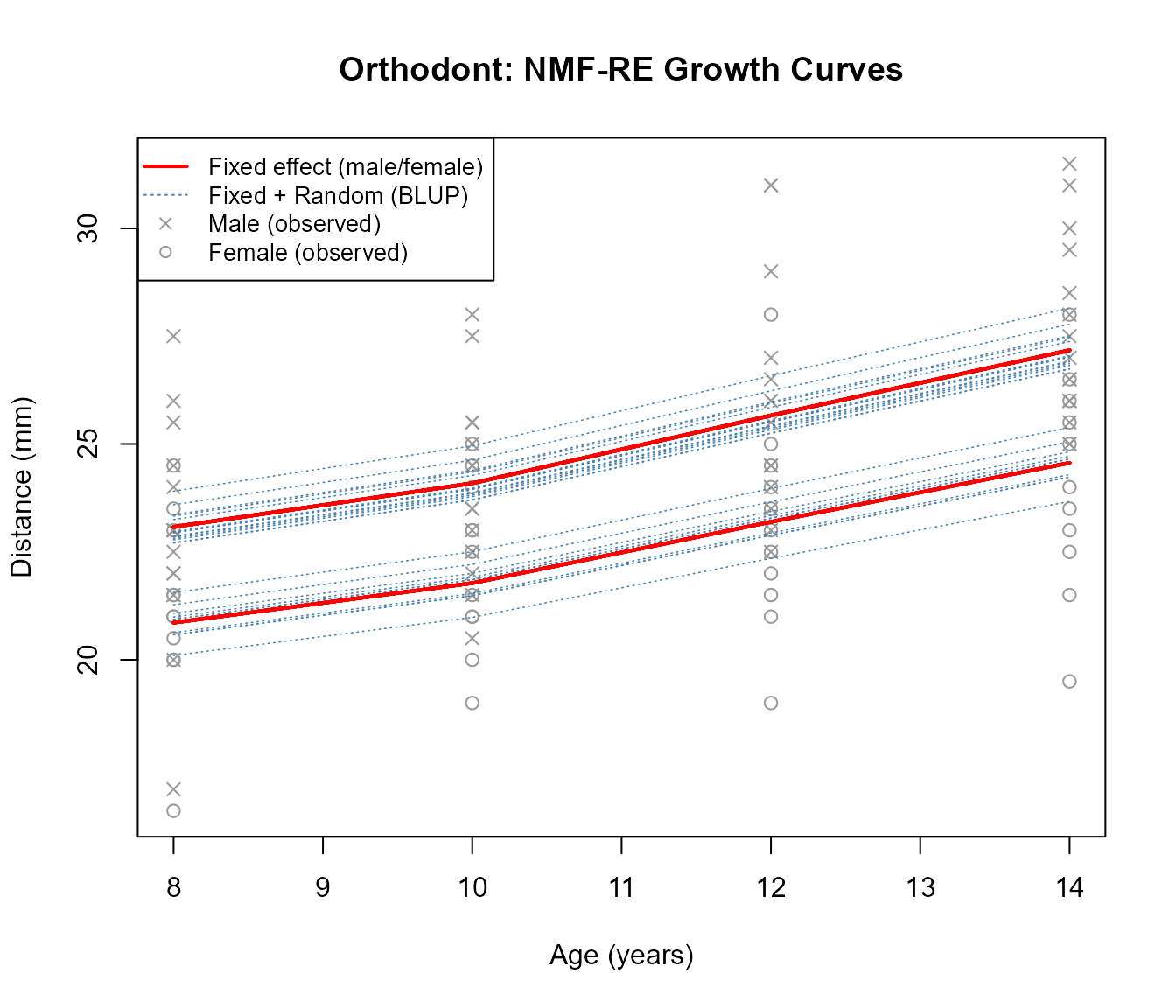
Interpreting the Plot
- Red solid lines: Population-level fitted values from fixed effects (\(X \Theta A\)). There are two distinct curves — one for males (higher) and one for females (lower) — reflecting the sex effect in \(\Theta\).
- Blue dashed lines: Individual-level predictions (\(X(\Theta A + U)\)). Each line is shifted from the population curve by the subject’s random effect \(U\), capturing personal growth trajectories.
- Gray points: Observed measurements. Crosses (\(\times\)) for males, circles (\(\circ\)) for females.
4. Examining Learned Components
4.1 Basis Matrix X
The basis \(X\) represents the latent temporal pattern shared across all subjects.
cat("Basis X (temporal pattern):\n")
#> Basis X (temporal pattern):
print(round(res$X, 4))
#>        Trend1
#> Age 8  0.2308
#> Age 10 0.2408
#> Age 12 0.2567
#> Age 14 0.2717
Since rank = 1, there is one basis vector. Its shape
shows how the latent factor manifests across the four ages. The column
is normalized to sum to 1.
4.2 Coefficient Matrix \(\Theta\)
\(\Theta\) (the C
element) maps covariates to latent scores:
cat("Coefficient matrix (Theta):\n")
#> Coefficient matrix (Theta):
print(round(res$C, 4))
#>        intercept   male
#> Trend1 90.5058 9.4227-
intercept: Baseline level of the latent trend for females. -
male: Additional contribution for males. A significant value indicates that males have higher orthodontic distances on average.
4.3 Random Effects U
\(U\) captures individual deviations. Subjects with positive \(U\) values grow faster than the population average; negative values indicate slower growth.
At convergence the random effects satisfy the identification condition \(U A^\top = 0\): they are orthogonal to the covariate rows, so \(U\) contains exactly the individual variation that the covariates cannot explain. (When \(A\) includes an intercept row, as here, this implies the familiar sum-to-zero centering of each row of \(U\) across subjects.)
barplot(res$U[1, ], names.arg = colnames(Y),
        las = 2, cex.names = 0.7,
        col = ifelse(male == 1, "steelblue", "salmon"),
        main = "Random Effects (U) by Subject",
        ylab = "Random effect value")
legend("topright", fill = c("steelblue", "salmon"),
       legend = c("Male", "Female"), cex = 0.85)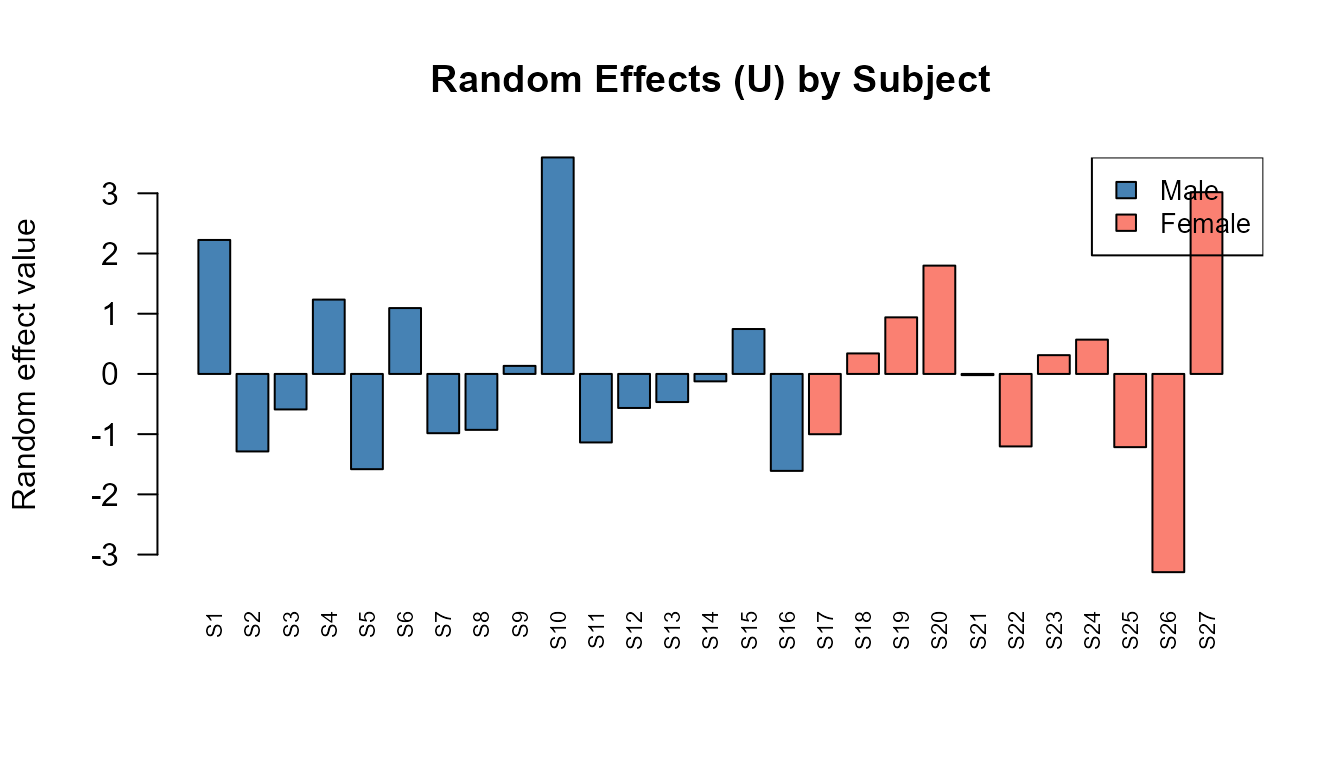
5. Model Diagnostics
5.1 Convergence
Check that the algorithm converged properly:
cat("Converged:", res$converged, "\n")
#> Converged: TRUE
cat("Iterations:", res$iter, "\n")
#> Iterations: 41
cat("Stop reason:", res$stop.reason, "\n")
#> Stop reason: outer_lambda
plot() shows the marginal negative
log-likelihood \(\ell(X,\Theta,\sigma^2,\tau^2)\) (random
effects integrated out), which the ECM algorithm decreases
monotonically. Note that the fixed-\(\lambda\) penalized objective
(res$objfunc.iter) is not monotone across outer
iterations — it jumps each time \(\lambda =
\sigma^2/\tau^2\) is updated — so it is unsuitable for
illustrating convergence.
plot(res, main = "Convergence (marginal NLL)")
5.2 Residual Analysis
Compare the fitted values against the original data:
residuals <- Y - res$XB.blup
cat("Mean absolute residual (BLUP):", round(mean(abs(residuals)), 4), "\n")
#> Mean absolute residual (BLUP): 0.8799
cat("Mean absolute residual (fixed):", round(mean(abs(Y - res$XB)), 4), "\n")
#> Mean absolute residual (fixed): 1.759

# Fitted vs Observed
plot(as.vector(Y), as.vector(res$XB.blup),
     xlab = "Observed", ylab = "Fitted (BLUP)",
     main = "Observed vs Fitted", pch = 16, col = "steelblue")
abline(0, 1, col = "red", lwd = 2)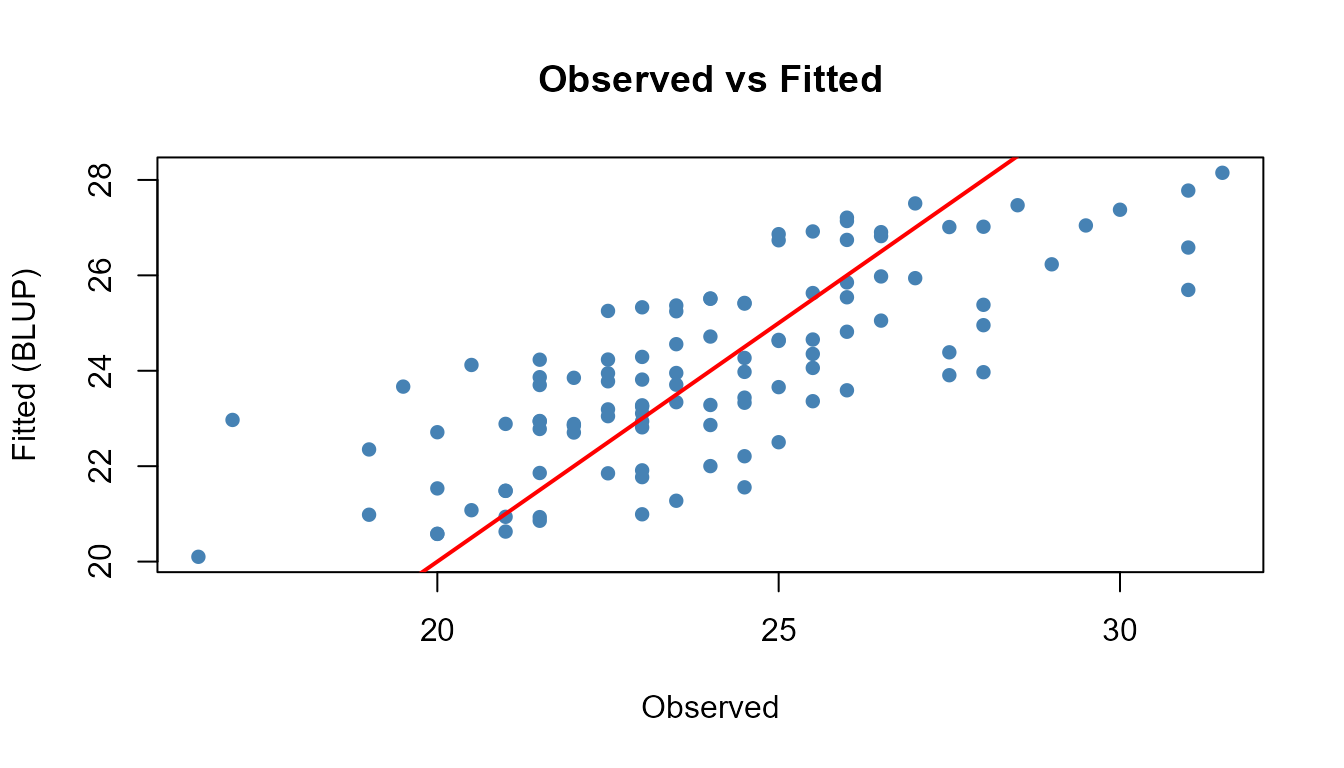
6. Comparison: With and Without Random Effects
To appreciate the value of random effects, compare NMF-RE with a standard NMF covariate model (no random effects).
# Standard NMF with covariates (no random effects)
res_fixed <- nmfkc(Y, A = A, rank = 1)
#> Y(4,27)~X(4,1)C(1,2)A(2,27)=XB(1,27)...0sec

cat("=== Standard NMF (fixed effects only) ===\n")
#> === Standard NMF (fixed effects only) ===
cat("R-squared:", round(1 - sum((Y - res_fixed$XB)^2) / sum((Y - mean(Y))^2), 4), "\n\n")
#> R-squared: 0.4161

cat("=== NMF-RE (fixed + random effects) ===\n")
#> === NMF-RE (fixed + random effects) ===
cat("R-squared (XB):      ", round(res$r.squared.fixed, 4), "\n")
#> R-squared (XB):       0.4167
cat("R-squared (XB+blup): ", round(res$r.squared, 4), "\n")
#> R-squared (XB+blup):  0.8246
cat("ICC:                 ", round(res$ICC, 4), "\n")
#> ICC:                  0.61
The improvement from fixed-only \(R^2\) to BLUP \(R^2\) quantifies the contribution of individual random effects.
7. Why optimization and inference are separated
Because nmfre() does not run the bootstrap, fitting is
cheap — useful when the model is fitted many times (rank selection,
cross-validation). Run nmfre.inference() only on the final
model, and re-run it (without re-fitting) to try different settings such
as the number of bootstrap replicates, confidence level, or p-value
sidedness:
# coefficient table from the inference object built in Section 2.2
res$coefficients[, c("Basis", "Covariate", "Estimate", "SE", "p_value")]
#>    Basis Covariate  Estimate       SE     p_value
#> 1 Trend1 intercept 90.505774 2.471719 0.000000000
#> 2 Trend1      male  9.422697 3.056691 0.002051691
Visualization with nmfkc.DOT()
The inference result is compatible with nmfkc.DOT() for
graph visualization. Edges are filtered by significance level and
decorated with stars:
8. Non-negative Coefficients (C.signed = FALSE)
When the latent scores are compositional or intensity-type and the
covariate effects must be non-negative, set
C.signed = FALSE. The basis is then updated by a
positive-part multiplicative rule and inference switches to a one-sided
(boundary) test.
res_nn <- nmfre(Y, A, rank = 1, prefix = "Trend", C.signed = FALSE)
res_nn <- nmfre.inference(res_nn, Y, A, wild.B = 500)
cat("All Theta >= 0 :", all(res_nn$C >= 0), "\n")
#> All Theta >= 0 : TRUE
cat("P-value side   :", res_nn$C.p.side, "\n")
#> P-value side   : one.sided
res_nn$coefficients[, c("Basis", "Covariate", "Estimate", "SE", "p_value")]
#>    Basis Covariate  Estimate       SE       p_value
#> 1 Trend1 intercept 90.431326 2.460762 5.959241e-296
#> 2 Trend1      male  9.543432 3.043119  8.561451e-04
For the Orthodont data the male effect is positive, so the sign-free and non-negative fits agree on its direction; the difference matters when an effect is genuinely negative (the non-negative variant clips it to zero).
Summary
NMF-RE provides a principled way to model individual heterogeneity in NMF:
| Step | Function | Purpose |
|---|---|---|
| 1 | nmfre() |
Fit the mixed-effects model (optimization only; variances estimated by EM/ECM) |
| 2 | nmfre.inference() |
Standard errors, p-values, and CIs for \(\Theta\) |
| 3 | summary() |
Examine variance components and the coefficient table |
| 4 | nmfkc.DOT() |
Visualize with significance stars |
When to use NMF-RE:
- Longitudinal or repeated-measures data where subjects differ systematically.
- Panel data with unit-level heterogeneity.
- Any NMF application where fixed covariates alone leave structured residual variation.
Choosing C.signed: keep the default
TRUE (sign-free, two-sided) when covariate effects can be
positive or negative; use FALSE (non-negative, one-sided)
for compositional or intensity scores.
For more details on the underlying methodology, see:
- Satoh, K. (2026). Wild Bootstrap Inference for Non-Negative Matrix Factorization with Random Effects. arXiv:2603.01468. https://arxiv.org/abs/2603.01468