R package implementing the methodology of Satoh (2026): visualisation of longitudinal binary data (a time × attribute 0/1 matrix) by a locally weighted Jaccard distance, multidimensional scaling with sequential modification (Mizuta, 2003), Ward clustering on a trajectory distance, and a functional Rousseeuw silhouette criterion for joint selection of bandwidth and class number.
Animated examples
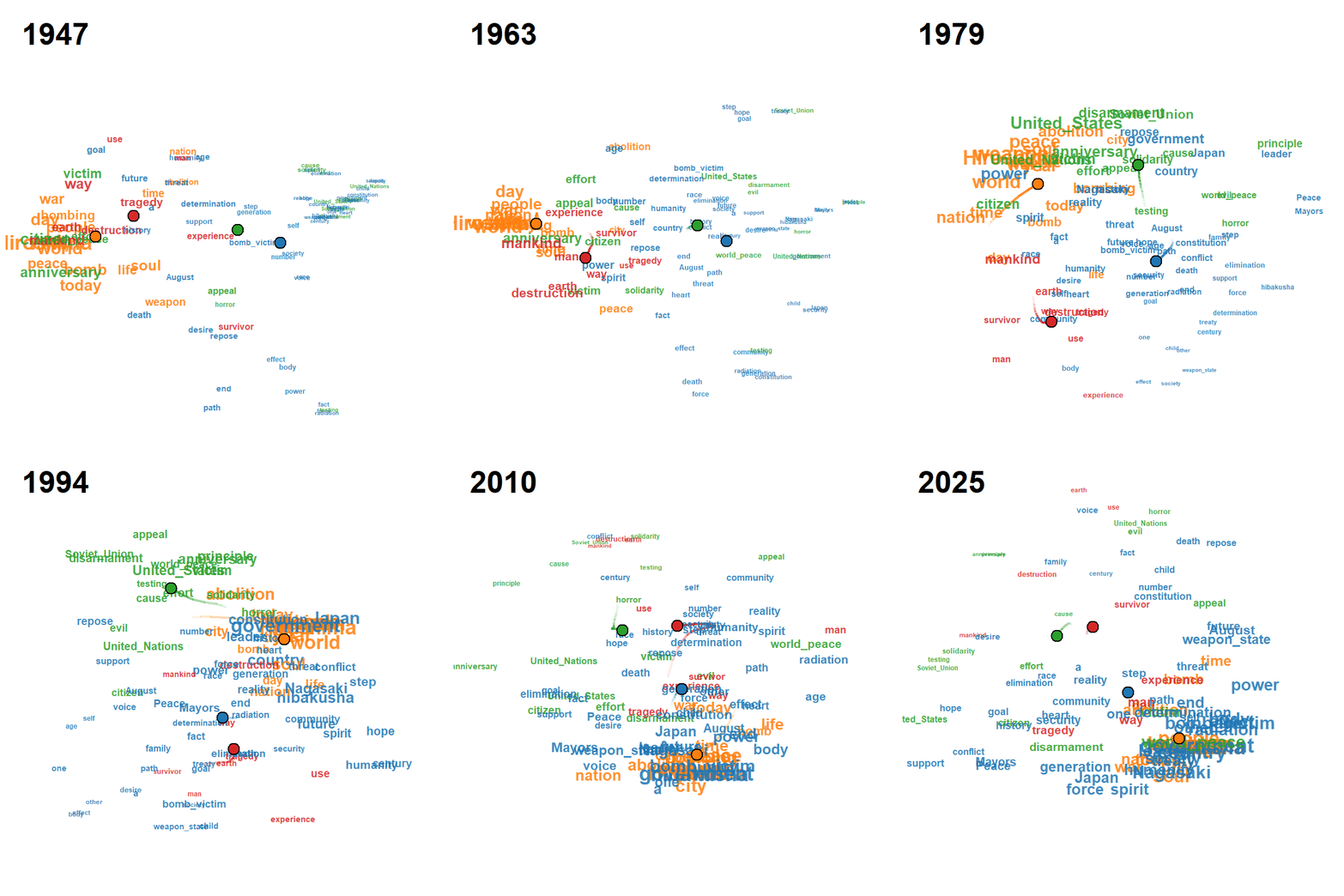
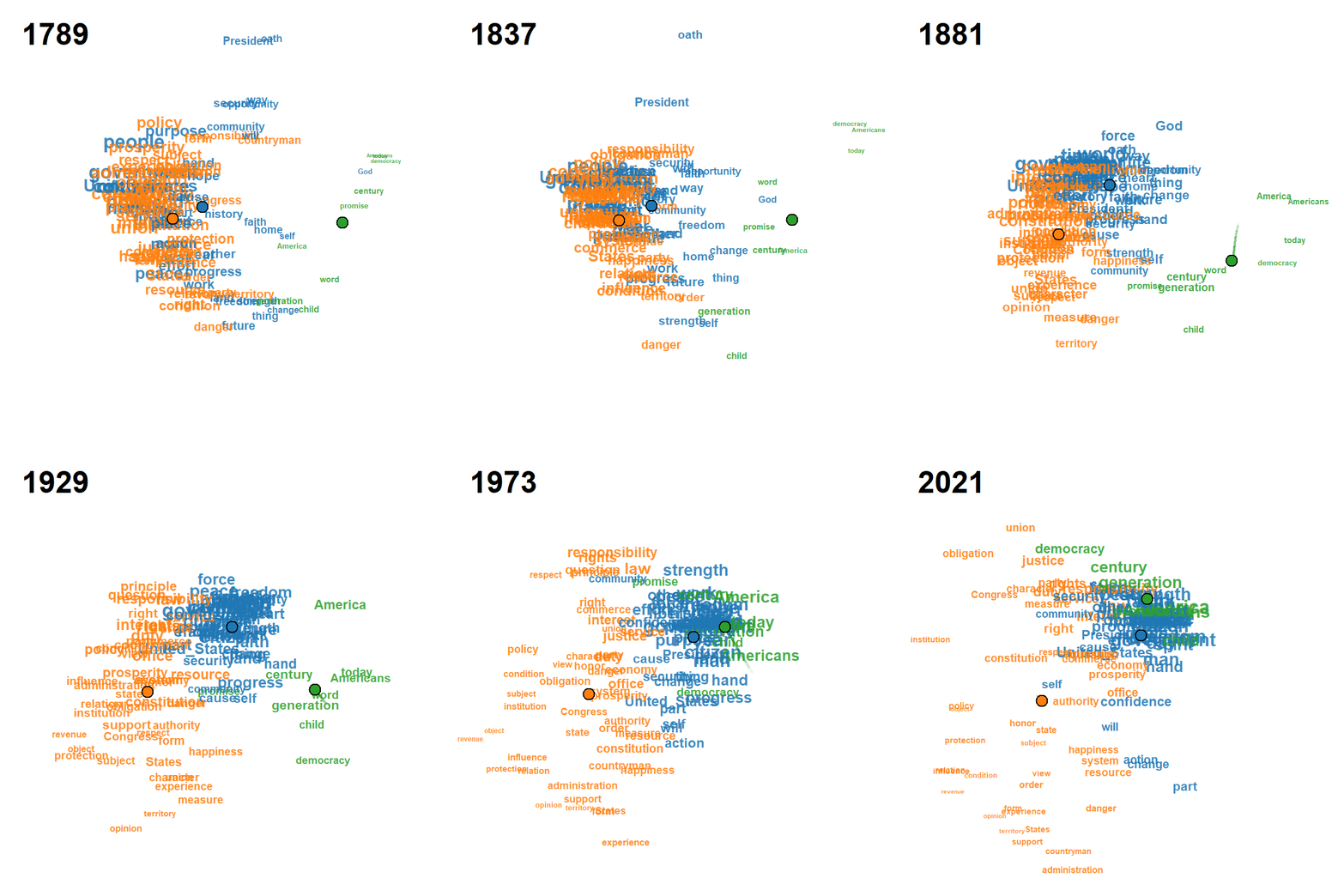
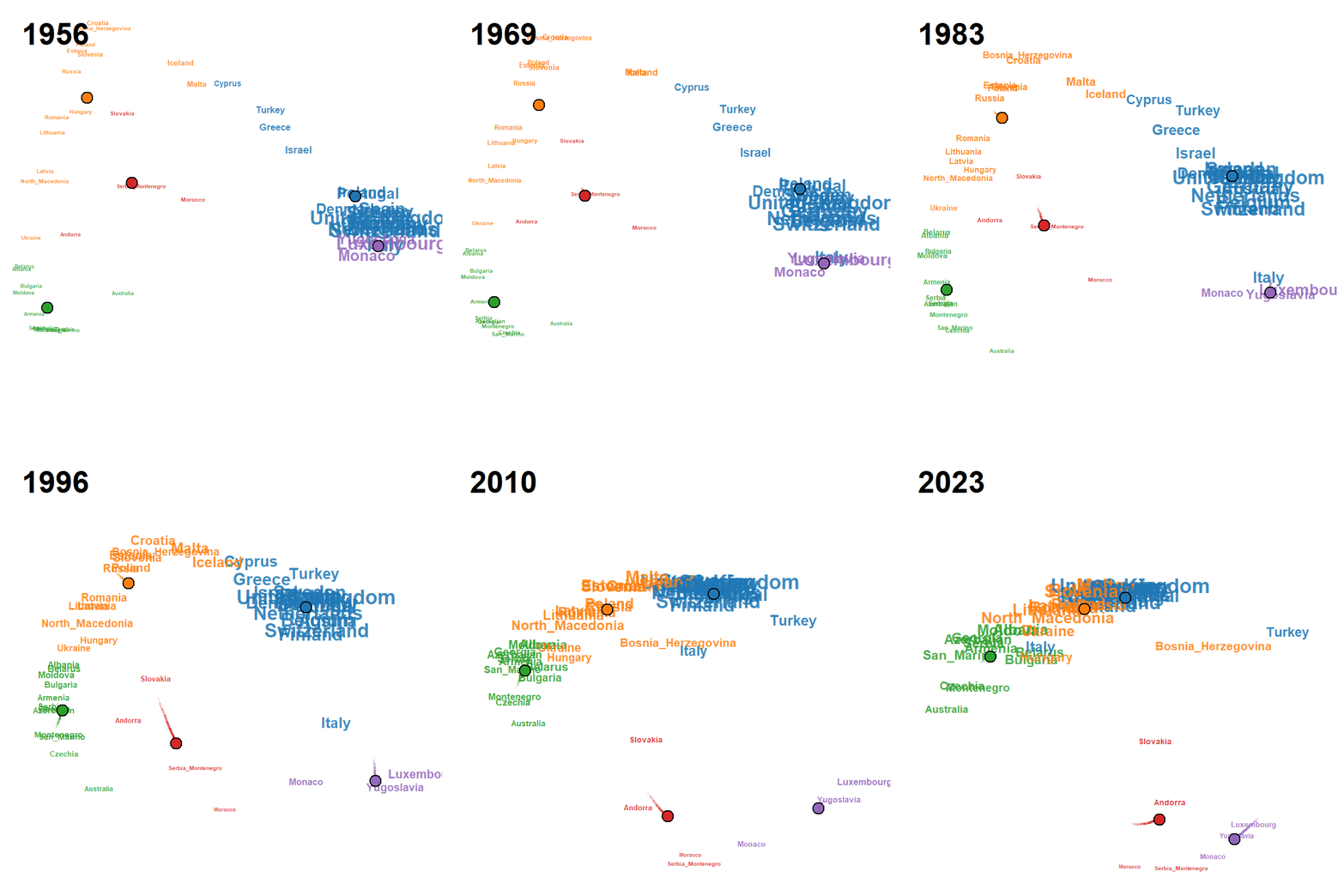
Each frame plots the attributes on the modified MDS configuration at calendar year , with font/symbol size proportional to the smoothed occurrence and a fading trail of class centroids over the previous frames. Cluster colours follow the default Classic Tableau palette and the silhouette criterion jointly selects from a user-supplied grid.
| Peace Declaration of Hiroshima (1947–2025, , ) | US Presidential Inaugural Addresses (1789–2021, , ) | Eurovision Song Contest (1956–2023, , ) |
|---|---|---|
 |
 |
 |
Installation
# Install from GitHub
remotes::install_github("ksatohds/ljmds", build_vignettes = TRUE)
Quick start
library(ljmds)

# Peace Declaration of Hiroshima (built-in)
d <- ljmds.read.csv("peace_declaration")   # year + 95 keyword 0/1 columns
# d <- ljmds.read.csv("inaugural")          # alternative built-in
# d <- ljmds.read.csv(file = "my.csv")      # external CSV

# Joint (h, k) selection over a grid
# k = 1, 2 are excluded by leaving them out of k.grid (default 3:6).
sel <- ljmds.select(d$X, d$t,
                    h.grid = c(3, 4, 5, 6, 8, 10, 12, 15, 20))
sel$h.hat   # 8
sel$k.hat   # 4
sel$S.hat   # 0.201

# Full pipeline
fit <- ljmds.pipeline(d$X, d$t, h = sel$h.hat, k = sel$k.hat)

# Figures (default class.col = grDevices::palette.colors(8, "Classic Tableau"))
plot(fit, type = "trajectory")    # centroid trajectories on MDS map
plot(fit, type = "dendrogram")    # Ward dendrogram + class boxes
plot(fit, type = "cmd")           # time-collapsed MDS of trajectory distance
plot(fit, type = "means")         # class mean occurrence curves
plot(fit, type = "panels")        # per-class small multiples (square layout)
plot(sel)                          # silhouette heatmap with maximizer marker

# GIF animation
ljmds.animate(fit, file = "peace_declaration.gif", trail = 10, fps = 2)
Data
Three longitudinal binary datasets ship under inst/extdata:
| File | n × p | Domain | Coverage |
|---|---|---|---|
peace_declaration.csv |
78 × 95 | Text | Peace Declaration of Hiroshima, 1947–2025 (no 1950) |
inaugural.csv |
59 × 106 | Text | US Presidential Inaugural Addresses, 1789–2021 |
eurovision.csv |
68 × 52 | Non-text | Eurovision Song Contest country participation, 1956–2023 |
Each file has a header row, column 1 named year, and columns 2.. giving 0/1 indicators. The two text datasets contain no source text, no word order and no frequency information: each cell records only whether a keyword occurred in a given year, so the original documents cannot be reconstructed. The bundled CSVs are thus derived binary indicator matrices (factual occurrence metadata), not the underlying texts; the texts remain the property of their respective rights holders (see Data sources and licenses).
Note (why a binary cell may not match a word search of the text). For the two text corpora the keyword columns are lemmatized, part-of-speech-filtered nouns, not the original surface words. A cell is
1when the lemma of a noun keyword occurred that year, so a plain text search will not reproduce the matrix exactly — e.g.countrycovers “countries”, and a word used only as a verb is not counted. The 0/1 values therefore reflect the UDPipe-processed keywords, not raw string occurrences.
Provenance
peace_declaration.csv (78 × 95, 1947–2025)
- Source: scraped from the City of Hiroshima official site (English Peace Declarations) at https://www.city.hiroshima.lg.jp/english/.
-
Pre-processing: tokenization, part-of-speech filtering and lemmatization with UDPipe (Straka & Straková, 2017) using the English Universal Dependencies model
english-ewt-ud-2.5-191206.udpipe(CC-BY-SA-NC). Adjacent noun pairs were merged into compound keywords (e.g.atomic_bomb,nuclear_weapons,United_Nations); words appearing 20+ times in the whole corpus were retained as keywords. - Year coverage: 78 years (1950 omitted because no declaration was delivered that year).
-
Reproducibility: the source texts were scraped with rvest, then tokenized and filtered with UDPipe + quanteda; the bundled CSV is the final 0/1 matrix without any source text. The UDPipe model was used only as an offline tool to build the CSV — it is downloaded by the user at preprocessing time (
udpipe::udpipe_download_model()) and is not bundled with, nor a dependency of, this package.
inaugural.csv (59 × 106, 1789–2021)
-
Source: derived from the
data_corpus_inauguralobject shipped with thequantedaR package (Benoit, K. et al., 2018, JOSS 3(30), 774). -
Pre-processing: same UDPipe + quanteda pipeline as the Peace Declarations; words appearing 50+ times retained as keywords; adjacent noun pairs merged (e.g.
United_States). - Year coverage: 59 inaugural addresses delivered between 1789 (Washington) and 2021 (Biden), at roughly four-year cadence.
eurovision.csv (68 × 52, 1956–2023)
- Source: derived from the Eurovision dataset of Spijkervet (2020) and the Mirovision living-dataset project of Burgoyne, Spijkervet & Baker (2023) at https://github.com/Amsterdam-Music-Lab/mirovision, released under the MIT licence by the Amsterdam Music Lab at the University of Amsterdam.
- Pre-processing: each row is a contest year, each column is a country, and the cell is 1 when that country fielded a contestant in that year and 0 otherwise. The 2020 contest was cancelled and is absent from the matrix.
- Year coverage: 68 contest years from 1956 (the first Eurovision Song Contest) to 2023.
-
Citations:
- Spijkervet, J. (2020). The Eurovision Dataset (version 1.0). Zenodo. doi:10.5281/zenodo.4036457
- Burgoyne, J. A., Spijkervet, J. & Baker, D. J. (2023). Measuring the Eurovision Song Contest: a living dataset for real-world MIR. In Proc. 24th International Society for Music Information Retrieval Conference (ISMIR), Milan, Italy. https://archives.ismir.net/ismir2023/paper/000097.pdf
Loading
d <- ljmds.read.csv("peace_declaration")  # or "inaugural" / "eurovision"
str(d)                       # list(t = numeric n, X = n×p 0/1 matrix,
                             #      keywords = column names of X)
Vignettes
Online versions are available at https://ksatohds.github.io/ljmds/articles/index.html.
vignette("quickstart-peace", package = "ljmds")
vignette("quickstart-inaugural", package = "ljmds")
vignette("quickstart-eurovision", package = "ljmds")
Each vignette starts from the bundled CSV and reproduces the diagnostic figures used in the corresponding application section of the paper.
References
- Rousseeuw, P.J. (1987) Silhouettes: a graphical aid to the interpretation and validation of cluster analysis. Journal of Computational and Applied Mathematics 20, 53–65.
- Mizuta, M. (2003) Multidimensional scaling for dissimilarity functions with continuous argument. Journal of the Japanese Society of Computational Statistics 15(2), 327–333.
Data sources and licenses
The three bundled CSV files are derived binary indicator matrices (see Data and Provenance). They contain no source text and constitute factual occurrence metadata; the underlying sources and their terms are:
-
inaugural.csv— US Presidential Inaugural Addresses are works of the US federal government in the public domain (17 U.S.C. §105), obtained from thedata_corpus_inauguralobject of thequantedaR package (Benoit et al., 2018). -
peace_declaration.csv— the English Peace Declarations are © the City of Hiroshima (https://www.city.hiroshima.lg.jp/english/). Only the derived binary occurrence matrix, which contains no source text, is redistributed here. -
eurovision.csv— derived from the Eurovision dataset of Spijkervet (2020) and the Mirovision project (Burgoyne, Spijkervet & Baker, 2023), released under the MIT License, Copyright (c) 2023 Amsterdam Music Lab.
The two text corpora were preprocessed with the UDPipe English-EWT 2.5 model (english-ewt-ud-2.5-191206.udpipe, CC BY-NC-SA 4.0). The model was used only as an offline tool to create the binary CSVs (it is downloaded by the user at preprocessing time via udpipe::udpipe_download_model()); it is not a dependency of this package and is not redistributed here, so its terms do not attach to the derived matrices.
License
The ljmds package source code is released under the MIT License (see LICENSE, Copyright (c) 2026 Kenichi Satoh). The bundled datasets are derived binary indicator matrices governed by their own source terms, summarized under Data sources and licenses above.